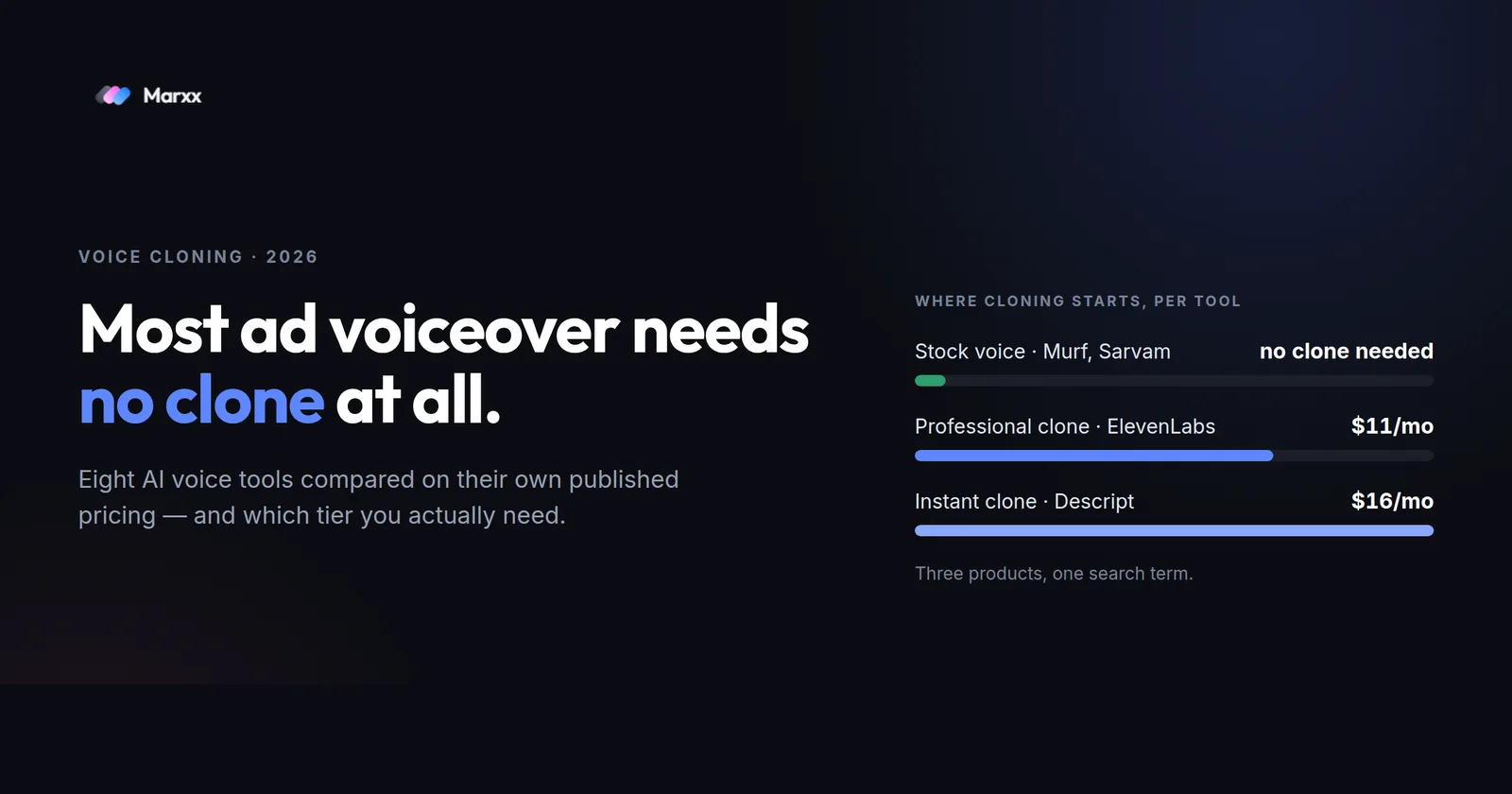
Most ad voiceover you want a stock synthetic voice, not a clone. If you do need a specific person's voice, ElevenLabs publishes the clearest pricing — professional cloning from $11/mo. If you need Indian languages, look at Sarvam or Camb.ai before the American tools.
Here's the full comparison, then the mistake that costs people the most money.
The eight tools, and what they publish

Every price above comes from the vendor's own pricing page, checked this month.
ElevenLabs — the default, and deservedly. 74 languages, instant cloning from the $1 Starter plan, professional cloning from $11 Creator with one clone, three on the $299 Scale plan and ten on $990 Business. It is also the only tool here that states plainly what you get at each tier.
Camb.ai — built for dubbing rather than voiceover, which makes it the interesting one for Indian advertisers. Free tier, then $5/mo Essentials up to $900/mo Expert, all credit-based. Cloning and live dubbing are both in the product.
Descript — cloning inside a video editor, so the voice fix happens where you're already cutting. From $16/mo Hobbyist with custom voice clones included, and AI credits of 400 to 1,500 a month depending on tier.
PlayHT — stock voices plus cloning, but you go through sales for the clone and the pricing page names tiers without numbers.
Murf — 120+ stock voices across 20 languages. Strong library; no price on the page we could read.
Sarvam — the strongest Indic option, and worth being precise about: it's text-to-speech, not cloning. Eleven Indic languages for TTS, twelve for speech recognition, a real API and a Python SDK. If you need a Tamil or Marathi read and don't need a specific person, start here.
Speechify — mainly a consumer reading app at $29/mo Premium. Its Studio product is priced separately and the consumer page lists no cloning.
Resemble — worth flagging. Their pricing page now sells deepfake detection, not voice generation: $0 Flex pay-per-use, $350/mo Team, $1,000/mo Business. If you arrived expecting a cloning tool, check what you're actually buying.
The mistake: three products share one name

This is where the money goes wrong. Most ad voiceover does not need anybody cloned. A stock synthetic voice is the right product and the cheapest tier. Teams skip it, buy an instant clone off a thirty-second sample, hear the artefacts in the first two seconds of a hook, and conclude AI voice isn't ready.
It's ready. They bought the wrong tier.
The rule: if a real person's identity is the point — your founder, a named creator, a presenter people recognise — you need professional cloning and its consent step. If you just need a clean, consistent read, you need a stock voice and you're done for a few dollars a month.
What it costs when you run the whole chain
Voice is one step. We ran a full generation on our own canvas to see what the real numbers look like: one ad asset cost 6 credits and under a minute. We then put it through a quality check against the brief and brand rules. It scored 65 out of 100 and failed. We fixed the flagged issues and regenerated; the second version scored 45 — worse, because fixing the brand problem broke the communication problem.
Two attempts, 12 credits, about four minutes, both failed review.
That's the honest shape of AI production, and it applies to voice as much as image. The value isn't that the first output is right. It's that being wrong costs four minutes instead of a re-booked studio session.
One thing the multilingual pitch gets wrong
The standard argument for cloning in India is reach: clone once, run in ten languages. We checked whether the big spenders do this.
Across 13,176 decoded ads from three Indian D2C brands, 94.3% are in English or Hinglish. Every regional language combined accounts for 4.9%. Bombay Shaving Company has run ads in 13 languages — so they know the option exists — and the regional variants sit under 7% of their mix.
The dubs also tend to run shorter. BSC's English ads average 16.5 days live against 10.1 for Marathi and 12.9 for Tamil. Foxtale's English ads average 60.0 days against 16.6 for Tamil.
Honest caveat: those regional counts are small, 4 to 155 ads, so the longevity gaps are near noise, and there are exceptions — boAt's Hindi ads average 31.3 days against 20.7 for English. This is Meta paid social only; YouTube and connected TV are a different market.
The useful conclusion isn't "regional doesn't work." It's that a dubbed English ad with a Tamil voice track is not a Tamil ad — the script, casting and offer were built for a different listener, and no voice model fixes that. Buy voice tools for production throughput. Buy a regional creative brief for regional reach.
Before you clone anyone
You need the speaker's explicit, documented consent, covering the uses you actually intend — paid ads, edited scripts, which markets, for how long. A verbal yes from a founder who later leaves is not a licence, and a voice actor's session fee does not include the right to synthesise them afterwards unless the contract says so.
Professional tiers generally require a consent verification step for this reason. Treat it as the floor. We're not lawyers; if you're cloning an employee's, creator's or customer's voice for paid media, have the terms reviewed.
Pick in one line
| If you need... | Use |
|---|---|
| A clean read across forty ad variants | Murf or any stock library voice |
| Indic-language TTS with an API | Sarvam |
| Dubbing existing video into other languages | Camb.ai |
| Your founder's actual voice, convincingly | ElevenLabs professional, from $11 |
| Voice fixes while editing the video | Descript, from $16 |
| A throwaway draft read to test a script | Any instant clone, then re-record the winner |
| Regional-language reach | A regional creative brief, not a voice tool |
FAQ
Is cloned audio good enough to run? Professional tier, yes. Instant clones from a 30-second sample usually betray themselves in the first two seconds, which is exactly where an ad lives or dies.
Will Meta penalise AI audio? We've seen no evidence of it. Judge it the way you judge any creative — how long the ad survives.
Do I need to disclose it? Rules vary by market and are moving. The practical line: never use a cloned voice to imply a real person endorsed something they didn't.
Cheapest way to start? ElevenLabs' free tier to test, then $11 Creator if you need one professional clone. Under $15 to find out whether this fits your workflow.
What about Hindi and regional languages? Sarvam for TTS, Camb.ai for dubbing. Both handle Indic languages natively rather than as an afterthought.
Can I clone a voice actor I hired? Only if that's specifically written into the contract with scope and duration. This is the most common place teams get it wrong.
Voice is one node, not the workflow
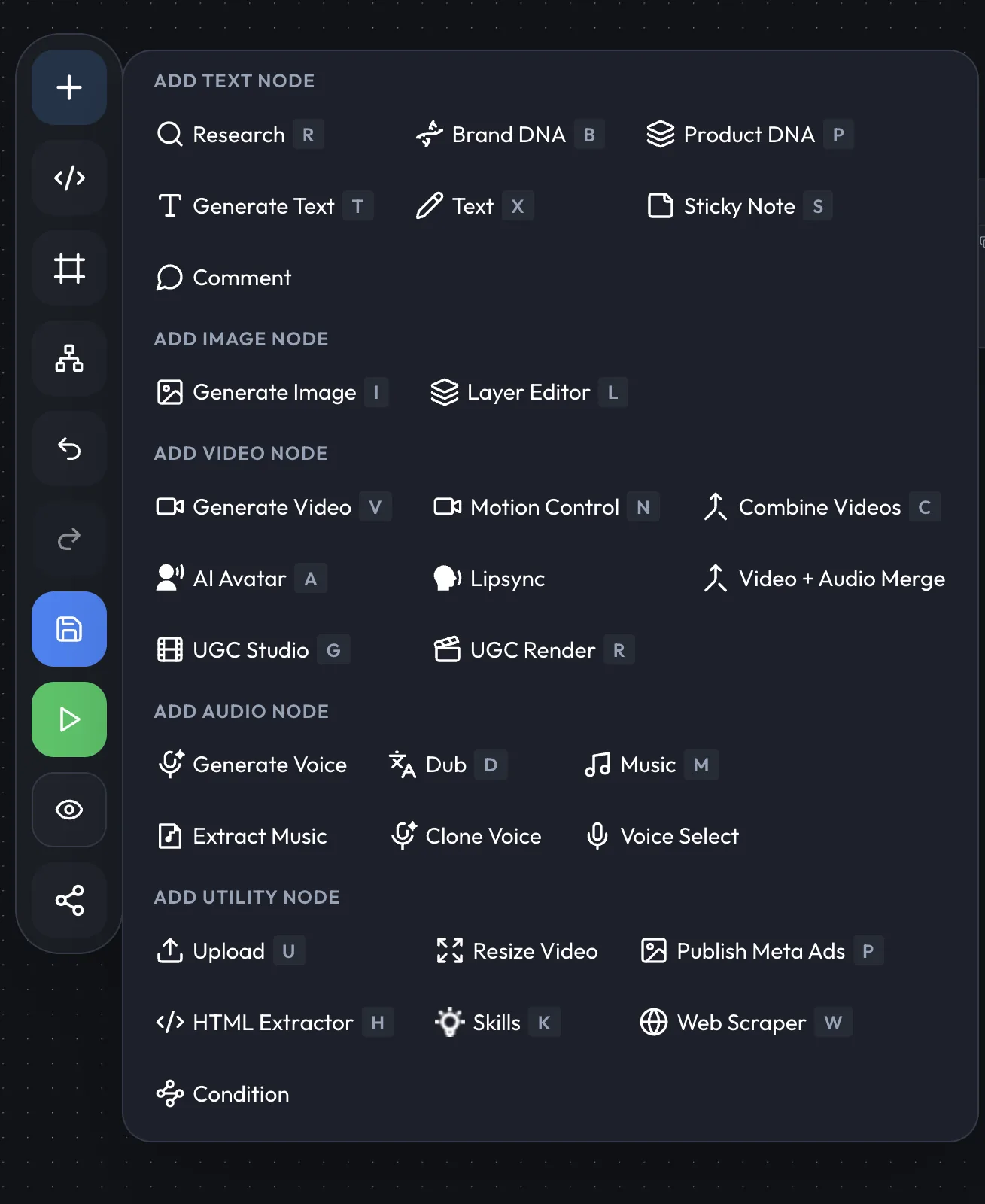
Our generation canvas carries the whole chain — script, voice and voice cloning, AI avatar, UGC studio, lipsync, and resize for every placement — so one brief comes out as several finished variants in a single run, rather than four tools stitched together by hand.
Trial the canvas: turn one brief into a finished ad. Book a demo — bring a script and a voice sample, and we'll build the variants live.