Start with the thing most guides won't say: you cannot see a competitor's keyword list. It isn't public, no tool has it, and anything presenting itself as "their keywords" is a model's guess.
What you can do is read it backwards off their ads — free, in about thirty minutes, and more accurate than the estimates.
Here's the method, run live on a real Indian advertiser.
Step 1: Find out who you're actually bidding against
Open Google Ads → your Search campaign → Auction Insights. This is the only source anywhere that names the advertisers appearing in the same auctions as you, with their impression share and overlap rate.
Do this before anything else. The competitor you assumed matters often isn't in your auction, and a company you've never heard of is taking 40% impression share on your best terms. Everything downstream is wasted if you research the wrong rival.
Run it at campaign level and then again at ad-group level — the names change between them, and the ad-group view tells you who owns a specific intent.
Step 2: Pull every live ad they run
Go to the Google Ads Transparency Center. No login, no payment. Search the advertiser, set the region, then filter format to Text — that's Search.

We ran this on Urban Company for India in October 2026: roughly 5,000 live ads in total, about 300 of them text. Those 300 are the Search account, laid open. Note the ad cards already showing sitelinks — that's step 3 doing itself.
Step 3: Read the headline, the path and the sitelinks
This is the part people skip. A Search headline isn't creative writing — Google rewards close keyword-to-headline match, so advertisers put the keyword in the headline deliberately. The display path and sitelinks then confirm it.

The display path gives the ad group name almost verbatim: /ac/repair, /appliance/repair, /electricians/near_you. You are reading their campaign structure off the URL.
Then the sitelinks list the neighbouring ad groups in the same campaign.

Sixteen sitelinks, read off six ads. That's a service-line map of their Search account, free, in about ten minutes.
Two patterns worth naming from this one account:
They own the "near me" cluster. Near me or near you appears across salon, electrician, plumber, carpenter and cleaning. That isn't five accidents; it's a deliberate local-intent build.
They put price in the headline on high-intent terms. Starts At Rs 2,999 for deep cleaning, House Help For Just Rs 79. Price in a headline usually means the keyword is price-qualified and they're filtering clicks before paying for them.
Step 4: Rank the sources by how much they actually know

Three of these four are free, and the free ones are the truthful ones — they show what the advertiser literally published. Paid tools are genuinely useful for the opposite job: estimating volume and surfacing terms you haven't thought of. Just don't treat their keyword list as a readout of someone's account, because it isn't one.
Step 5: Build the sheet

Fill thirty rows and the patterns become obvious: which services get dedicated ad groups, which get lumped together, where they lead with price, and which intents they've left alone entirely.
The honest limits. The Transparency Center shows ads live now — not spend, not what they tried last quarter. It won't show match types, negatives, bids or budgets, which are the four things that most determine what actually happens in the auction. And a long-running ad means the advertiser kept it, not that it was profitable.
So this method gives you their intent map reliably and their economics not at all. Treat it as the input to your own testing, not a finished answer.
Do it on yourself first
Search your own brand in the Transparency Center and read your ads the way you just read theirs. Most teams find at least one ad still running against a keyword they stopped caring about two quarters ago.
FAQ
Can any tool show a competitor's exact keywords? No. Semrush, Ahrefs and SpyFu all model it from search results and clickstream data. Useful estimates, not the list.
Is Auction Insights really free? Yes, inside your own Google Ads account. It needs enough impressions in the campaign to populate.
How often should I check? Monthly for the intent map. Weekly only during an active bidding war on specific terms.
What about Performance Max? PMax exposes no keywords at all, to you or anyone. The Transparency Center still shows the ads, which is often the only visibility available.
Does this work outside India? Yes — there's a region filter. Set it to the market you care about, since the ad set differs by country.
Is it legal? All four sources are public and Google publishes the Transparency Center deliberately. You're reading what they chose to make public.
Track it instead of redoing it monthly
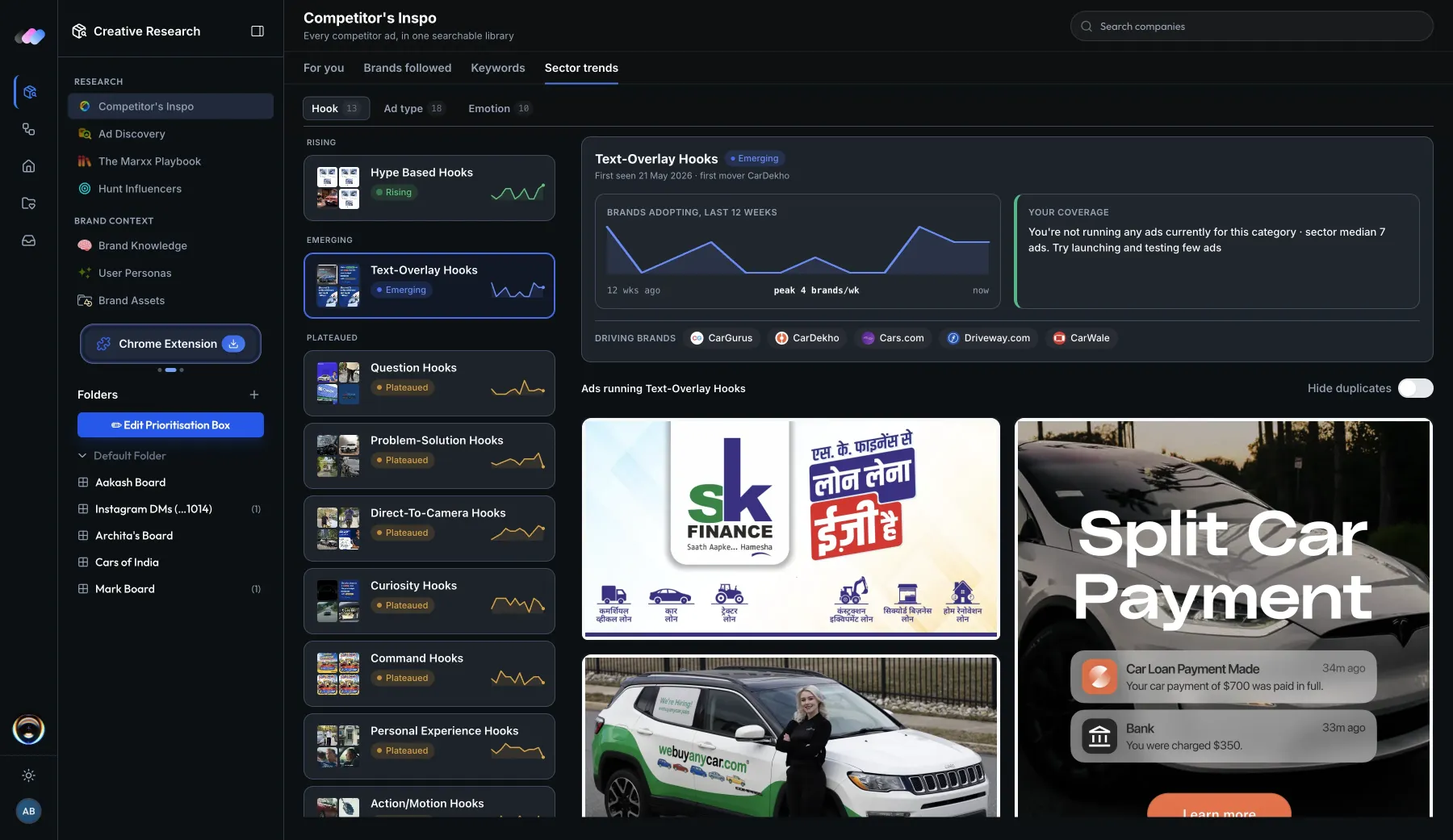
Our competitor tracking watches Meta, Google and keyword-level activity together, so new ads, new services and new angles surface as they launch rather than when you next remember to look.
Track your top 5 rivals, with a live teardown of their running ads. Book a demo — bring five competitor names and we'll build the intent map on the call.