Good creative brief templates are not hard to find. Milanote has 22. ClickUp has 11. Miro, Notion, Canva and HubSpot all give one away.
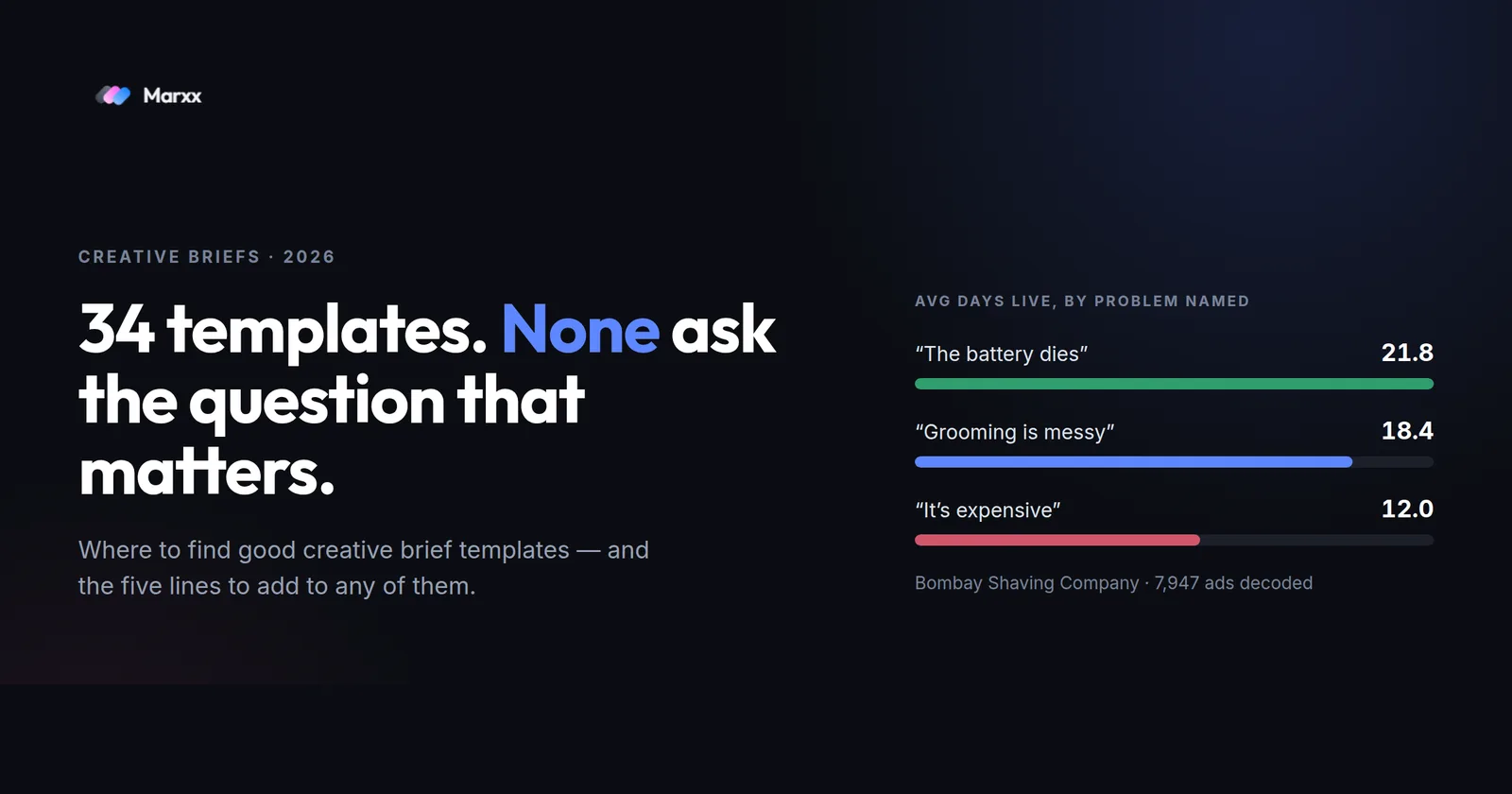
The links are at the bottom of this post. First, the part nobody tells you: we counted the fields on 34 of those templates, and not one of them asks the question that moved the number in our data.
The field that mattered
We decoded Bombay Shaving Company's live ad library — 7,947 ads scored by the problem the ad names — and ranked each problem by how long those ads survive in market.
| Problem the ad names | Share of ads | Avg days live |
|---|---|---|
| Frequent charging frustration | 5.4% | 21.8 |
| Grooming accessibility barrier | 8.2% | 21.2 |
| Unreliable grooming tools | 6.2% | 20.6 |
| Frequent grooming mess | 21.7% | 18.4 |
| High product costs | 20.4% | 12.0 |

One in five of their ads is built on "it's expensive." Those ads last twelve days. The ads built on "the battery dies" last twenty-two — nearly double, from the same brand, in the same category, in the same month.
That difference was decided in the brief, before anyone opened Figma.
Now the counter-example, from the same account. We ran the identical analysis on hook type across 8,533 ads. Problem-Solution hooks: 16.5 days. Price-Focused: 14.4. Oddly Satisfying: 19.4. Curiosity: 14.9. A spread of about five days across the whole field.
So in this account the problem field has roughly twice the variance of the hook field. Which means the lesson is not "always write the problem." It is: find which field has variance in your account, and make the brief force an answer to that one.
What 34 templates actually ask for

Count the fields on any template you download. They cluster into two groups: fields that organise the project, and fields that decide the creative. Almost every template is thorough on the first and silent on the second.
That's not incompetence. Those templates are built for design projects in general — a logo, a website, a photoshoot — where "tone of voice" and "deliverables" genuinely are the job. They were never built for paid social, where the same designer makes forty variants a month and the only thing separating them is the argument.
Where to actually get one
| Source | What you get | Cost |
|---|---|---|
| Milanote | 22 briefs by project type — advertising, social, video, photoshoot, UI | Free account |
| ClickUp | 11 design brief templates, docs and whiteboards | Free account |
| Miro | One two-page brief on a whiteboard, good for live sessions | Free |
| HubSpot | Classic marketing brief, document format | Free, email required |
| Notion / Canva | Duplicate-and-edit briefs inside tools you already use | Free tier |
All of these are fine. Pick whichever lives where your team already works — the best template is the one people actually open. Then do the next part, which is the part that matters.
The five lines to add to whatever you download
Paste these at the top of any template. They take three minutes to answer and they are the only three minutes that change the output.
- The problem this ad names. One sentence, in the customer's words. Not "quality concerns" — "the battery dies in a week."
- The objection it answers first. The reason someone who wants it still doesn't buy.
- The offer mechanic. Not "20% off" — whether it's a bundle, a gift, a trial, a payment plan. These behave very differently.
- The format this angle has to beat. Name the incumbent. If demos are your longest-running format, the brief should say so.
- What we already know dies fast. One line of institutional memory, so the same dead angle doesn't get re-briefed every quarter.
If your template has a "background" or "key message" box, these five can live inside it. You do not need a new tool.
The honest limit
Days live is not profit. A price-led ad that survives twelve days during a sale may be the most profitable thing the brand runs all quarter — it's doing a different job, and it's supposed to burn out. Longevity tells you what holds attention over time, not what converts hardest in a window.
Use it to decide which angles deserve a proper production budget, not to kill every short-lived ad.
FAQ
Is a free template good enough? Yes. Nobody's creative got worse because the brief was free. The failure is always in which fields it asks for, not which tool hosts it.
How long should a brief be? One page. If it needs two, the second page is reference material, not brief.
Who should write it — strategist or designer? Whoever can answer line one. If neither can name the customer problem in the customer's words, the brief isn't ready to be written.
How do I know which field has variance in my account? Decode your own ads by attribute and rank each value by how long it ran. If one field's spread is twice another's, that's the field your brief should interrogate.
Should I use AI to write briefs? For the logistics fields, it's faster than you. For lines 1 and 2 above it needs your account's data, or it will produce the same generic brief as everyone else's.
Briefs written from your own account
Our brief generation reads your decoded library and your audience personas, then writes the brief with those five lines already answered — the problem, the objection, the mechanic, the incumbent format, and what's already been tried.
Leave with one brief written from your account. Book a demo — bring one product you're about to make ads for, and you'll leave with the brief, not a template.