# How to Develop an Effective Creative Strategy for Paid Social
> Strategy is the chain of decisions made before any copy exists -- walked step by step and checked against live Meta ads.
- **Author**: Marxx
- **Published**: 2026-10-05
- **Category**: Creative strategy
- **URL**: https://marxx.ai/posts/creative-strategy-paid-social
---
Ask most teams for their creative strategy and you get a list of formats. Carousels for consideration. UGC for cold. A testimonial, a founder story, a comparison grid. That is not a strategy -- it is a production schedule with the thinking removed.
A creative strategy is the set of decisions you make *before* a single line of copy exists. It runs in a fixed order, and each step constrains the next: human reality, then moment, then tension, then the psychological job, then the insight, then the territory, then a hypothesis you can actually test. Copy is the output of that chain. It is never the input.
This piece walks the chain, and each step is checked against live Meta ads -- read on how long they stayed in market and how many near-identical copies the brand chose to run. Those two signals are the closest honest view anyone outside an account gets of what a brand believes is working.
## Step one: start from the situation, not the product
The first question is not "what should we say about our product." It is "what is happening in this person's life at the moment they would need it."
Family First Auto Sales, a used-car dealer in the US, runs an ad whose entire hook is *POV: you just got stationed at Fort Campbell.* Not "quality used cars." Not "easy financing." A specific thing that just happened to a specific person, on a specific day. It has been live 47 days and the brand runs two copies of it.
WesBank in South Africa does the same thing with a different moment: *finally time for your first car after graduating?* Live 40 days -- and the brand is running **eight near-identical copies** of it, the strongest conviction signal in this entire set.
Nuborrow, lending in Ontario, picks the moment a mortgage renewal letter lands: *don't renew your mortgage at that crazy high rate until you see this.* Live 125 days.
None of these ads lead with a product attribute. All three lead with a date on someone's calendar. That is what "start from the human situation" means in practice, and it is the step most teams skip entirely.
A persona that reads "males 25-40, urban, mid-income" cannot produce any of those three ads. A persona built from what customers actually said can.
That distinction matters more than any format choice downstream. Role in the situation beats demographic category every time, because the situation is what creates the need.
## Step two: find the tension -- don't invent one
A tension is something the person genuinely experiences, not a conflict you manufacture so the ad has somewhere to go.
The longest-running ad in this set belongs to Nissan of Roanoke Rapids, and its hook is: *tired of hearing "no" from car dealers and banks?* It has been live **177 days**.
There is no product feature in that line. There is no offer in it. It names a repeated humiliation that a specific group of people have actually lived through -- being declined, more than once, by institutions. Everything the dealership sells is positioned as the answer to that experience rather than as a set of attributes.
Contrast that with the invented tension, which usually sounds like a problem nobody has: "tired of boring skincare?" Nobody is tired of boring skincare. People are tired of spending money on things that did not work. The test is simple and ruthless -- would the person recognise this as something that actually happens to them, or merely agree that it is broadly true? "That's exactly what happens" is a tension. "Yeah, that's true" is not.
## Step three: a territory, not headline variations
This is where most creative strategies quietly fail, and it is the easiest failure to see from the outside.
An insight is only worth having if it opens a *territory* -- a space that generates many different executions, entry points, formats and attention mechanisms. If your insight produces one clever headline and four rewordings of it, you did not find an insight. You found a headline.
Motion is currently running three ads that all point at the same offer, the same landing page, the same report. Watch what varies.
The first opens on a near-refusal, set as the whole frame: *don't read this report.* It is a negative hook built on curiosity, and it has been live 32 days.
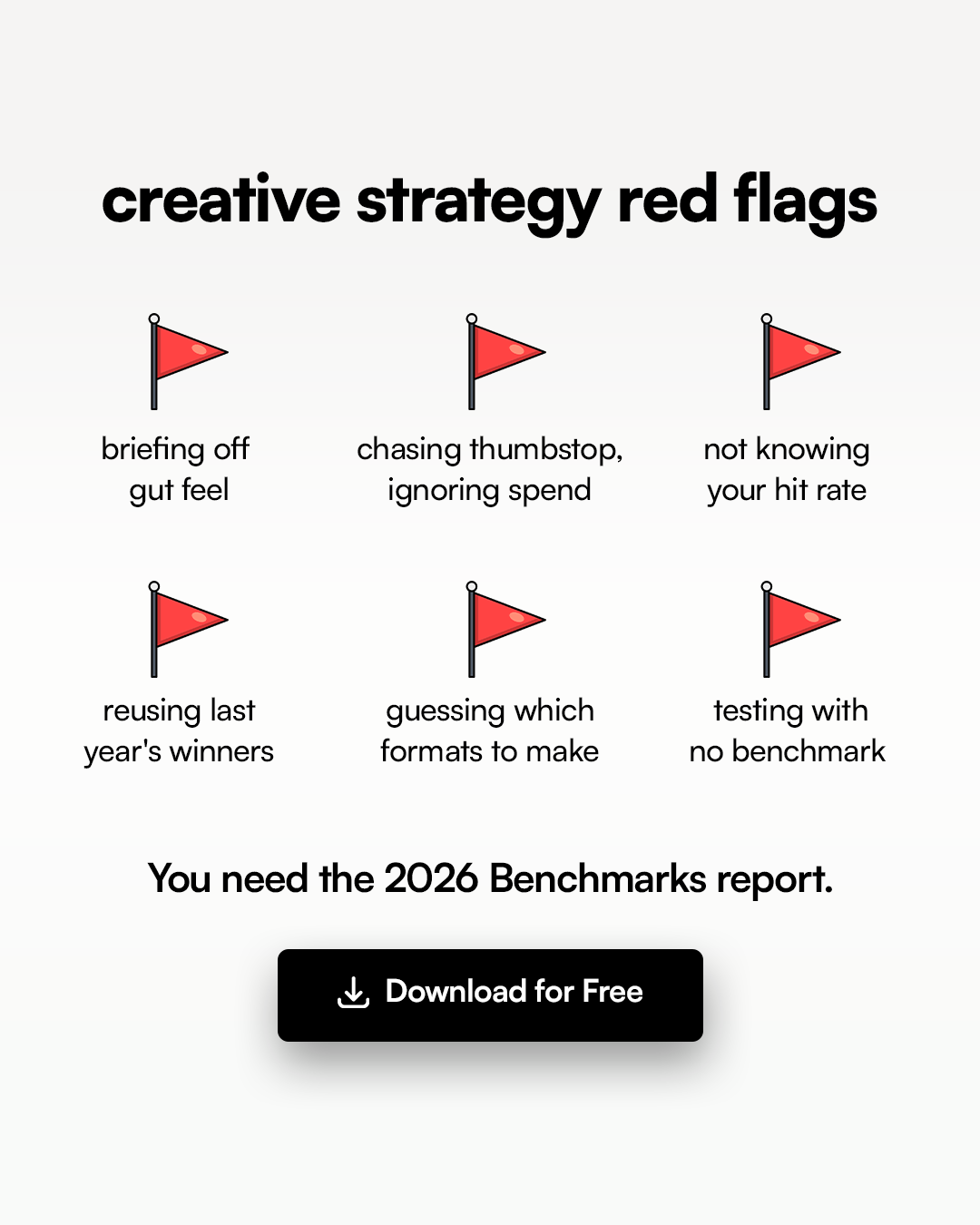
The second does not use a hook line at all. It lays out six specific failures -- briefing off gut feel, chasing if-else logic, not knowing your hit rate, reusing last year's winners, guessing which formats to make, testing with no benchmark -- as a diagnostic the reader runs on themselves. Different mechanism entirely: anxiety rather than curiosity. Live 25 days.
The third abandons both and leads with scale: *we analyzed 550,000 ads so you don't have to.* A credibility play, where the argument is the size of the work. Live 7 days.
Three ads, one offer, three genuinely different reasons to care -- refusal, self-diagnosis, authority. Each could spawn its own run of executions. That is a territory.
Now the counter-example, and it is instructive precisely because the brand is competent and the creative is well-made.
AdYogi is running three ads for its H2 Marketplace Events Playbook. All three launched on the same day. All three have been live 14 days. And all three carry the identical hook: *H2 Marketplace Events Playbook.*
The second changes the background from a dark graphic treatment to a photograph of a shopper.
The third changes it again, to a phone mockup showing the marketplace apps.
The headline never moves. The argument never moves. What is being tested here is art direction -- and art direction is the cheapest variable in the stack to change and the least likely to explain a result. If one of these wins, the team learns which image performed. They learn nothing about why anyone wants the playbook, which is the question that would unlock the next ten ads.
This is the single most common failure in paid social creative, and the fix costs nothing: before you brief three executions, write down the three *different arguments* they make. If you cannot, you have one ad and two backgrounds.
## Step four: the same buyer in a different state is a different brief
Lifecycle position is not a targeting setting. It changes who the person is.
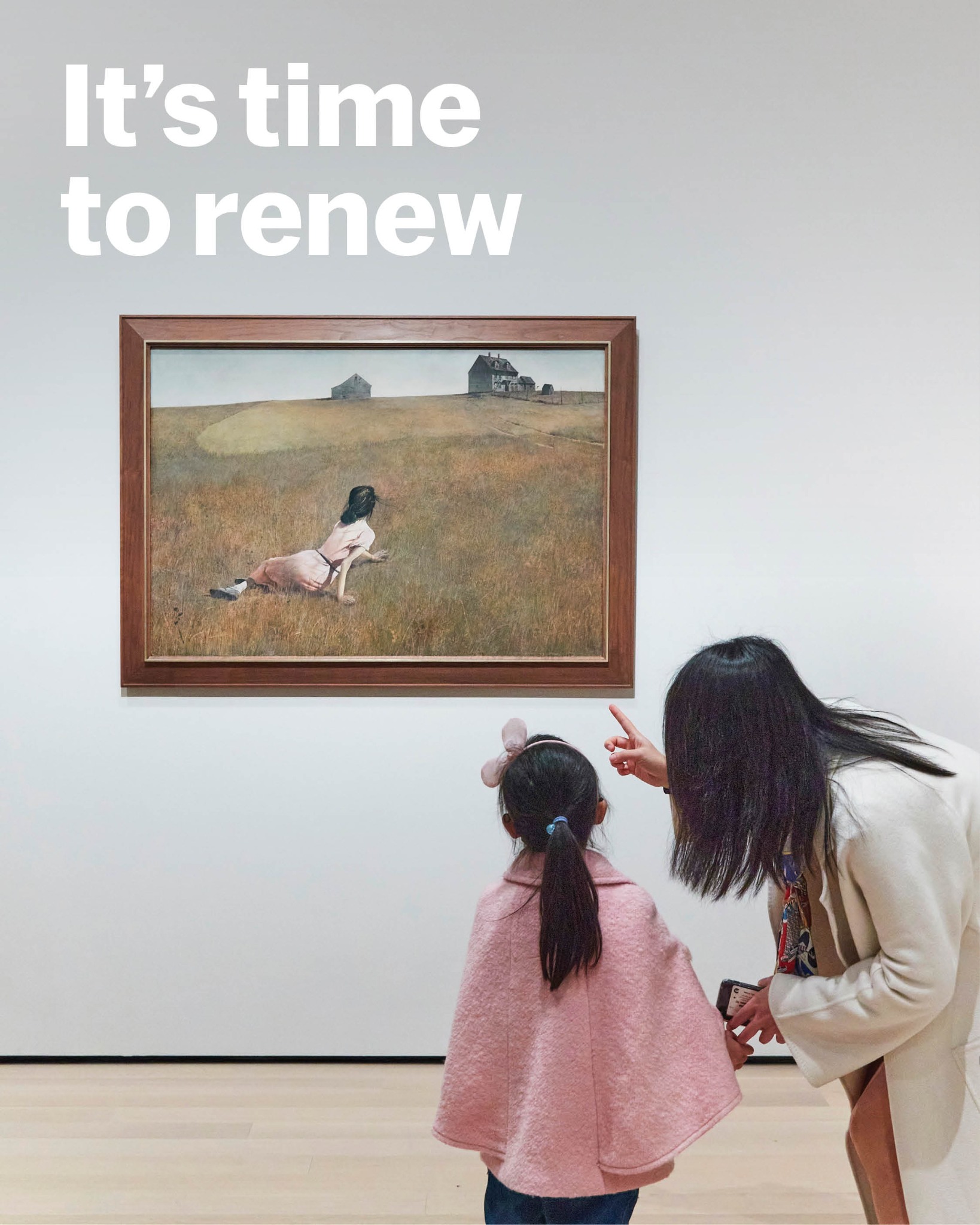
MoMA is running membership ads to two groups with the same product and completely different copy. To current members approaching expiry, the ad says *it's time to renew* -- a reminder, assuming the relationship already exists, with saving as the accelerator rather than the hook.
To lapsed members, the ad says *get two months free* and leads with belonging rather than reminder. It is a re-recruitment pitch, not a renewal nudge, and MoMA is running four near-identical copies of it against two of the renewal ad.
Same museum, same membership, same price. Two different human situations, so two different briefs. A strategy that treats "members" as one audience would write one ad and lose both.
## Step five: read conviction, not applause
Once ads are live, the useful signal is not which one your team likes. It is which one the brand keeps paying to serve, and how many copies of it they are willing to run.
| Signal | What it tells you | Example in this set |
|---|---|---|
| Long run, one copy | The idea works, the bet is contained | Nissan of Roanoke Rapids, live 177 days |
| Shorter run, many copies | High conviction, recently placed | WesBank, 40 days, 8 copies |
| Several copies of one angle | The territory is being scaled | MoMA lapsed-member ad, 4 copies |
| Many ads, one hook | No territory -- art direction testing | AdYogi, 3 ads, identical hook |
Reading only the longevity column will mislead you. A 40-day ad running eight copies is a bigger bet than a 125-day ad running one.
## Step six: know when the territory is spent
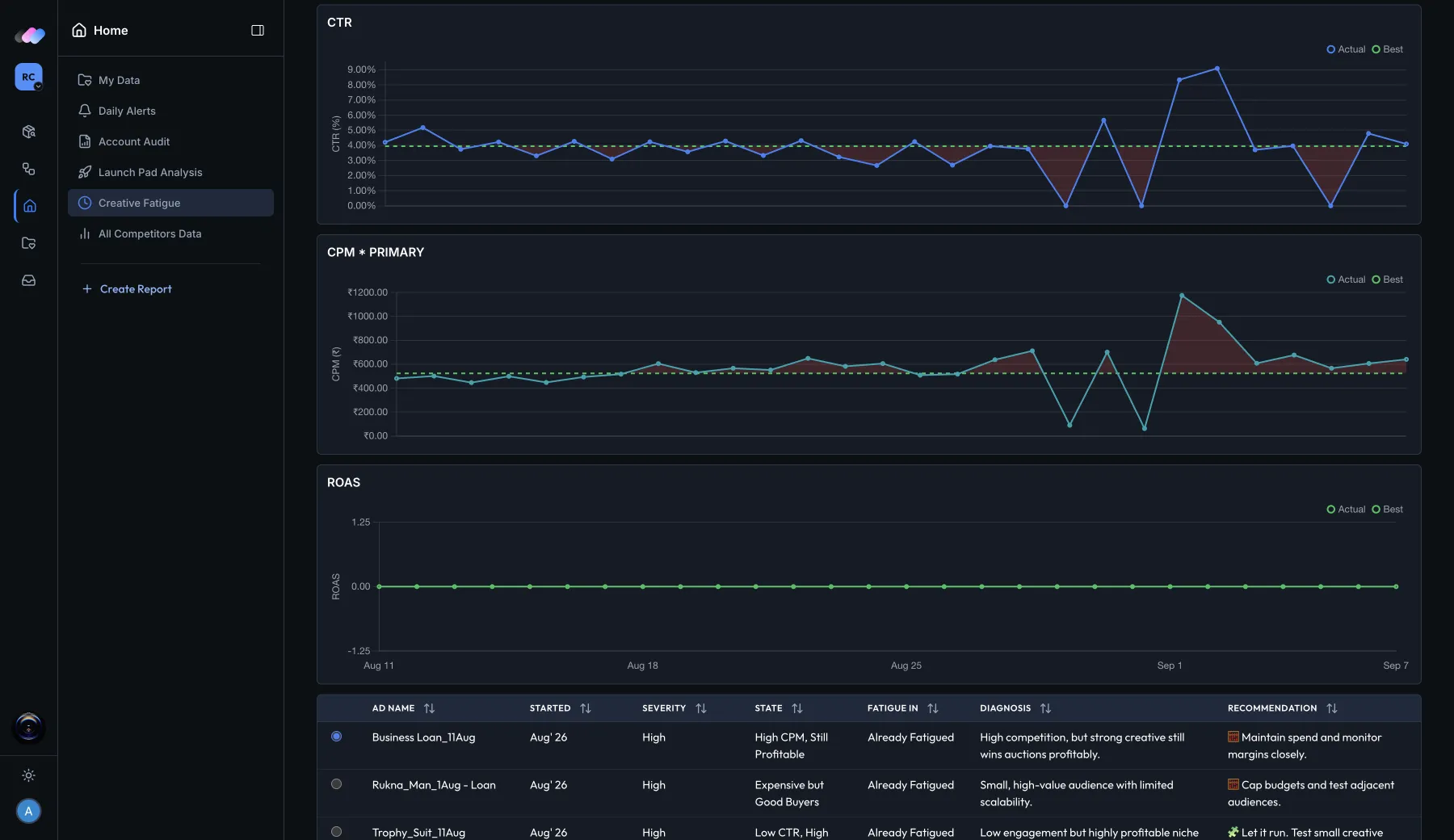
Territories exhaust. The insight stops being news, the hook stops interrupting, and the same creative that carried the account for two months starts costing more to deliver the same result. The failure mode is not noticing until the quarter is already soft.
The question at that point is not "make new creative." It is "which step of the chain do we go back to?" If the tension is still real and only the execution is tired, you re-enter at execution. If the moment itself has passed -- the festive window closed, the graduation season ended -- you go back to step one and find a new situation. Those are different amounts of work, and confusing them wastes a cycle.
## Writing the brief
Everything above produces one artefact: a brief that names the human situation, the moment, the tension, the psychological job, and the hypothesis being tested. If the brief does not name the hypothesis, there is nothing to learn from the test.
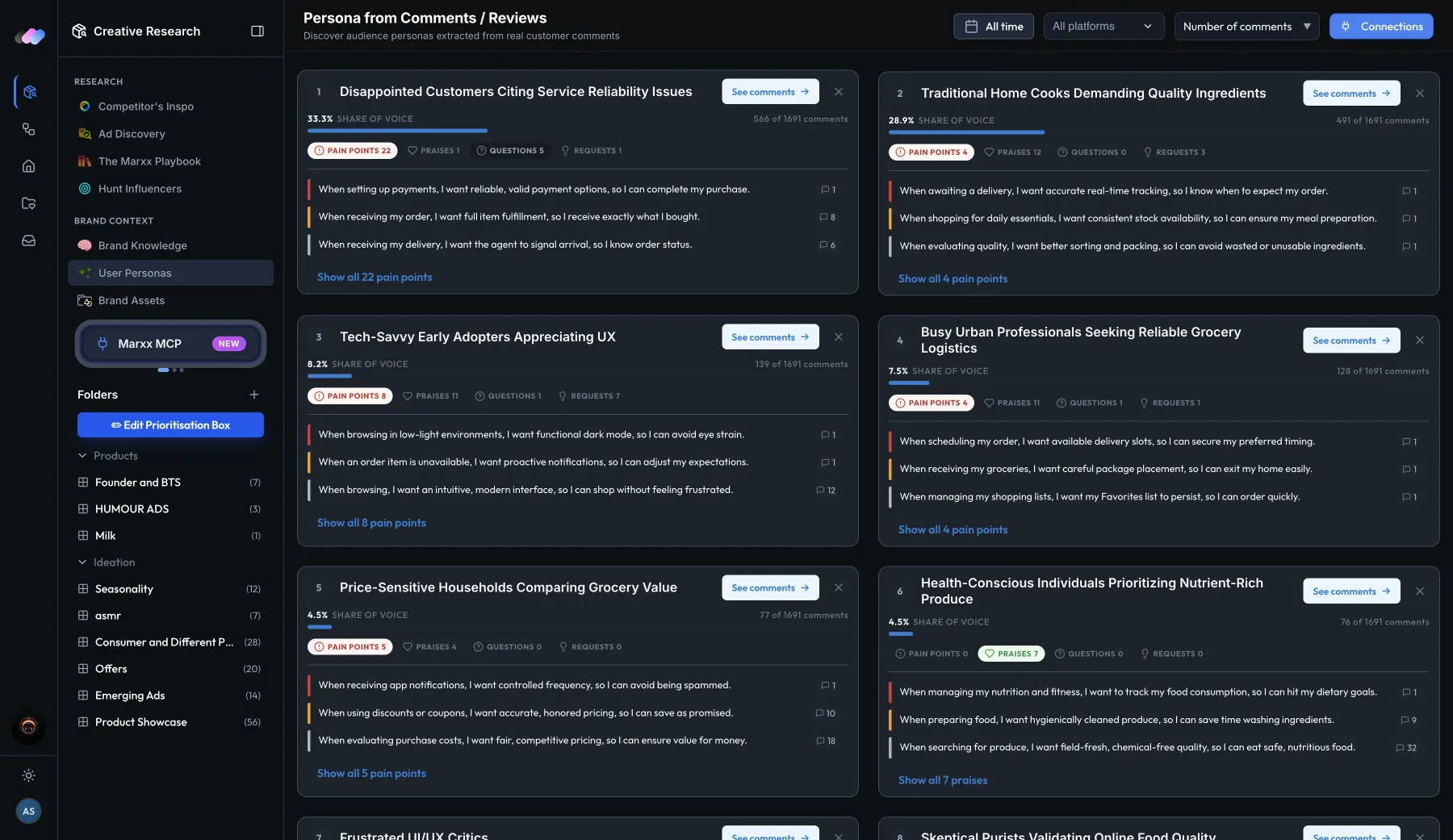
This is the part Marxx automates. Rather than starting a brief from a blank document, the brief is generated from your own account -- the personas built from what your customers actually wrote, the angles already running in your category, and which of your own creatives are decaying -- and it arrives where the work happens.
The output is a brief with a named hypothesis attached, not a prompt to go and think of something. You can pull the same reasoning into [Claude or ChatGPT through the Marxx MCP server](https://marxx.ai/mcp), or read the category evidence first on the [creative intelligence side of the product](https://marxx.ai/#intelligence).
## The chain, as a checklist
| Step | The question | You have failed it if |
|---|---|---|
| Human reality | Who is this person, in this moment? | Your answer is a demographic |
| Moment | What just happened, or is about to? | Nothing is time-bound |
| Tension | What do they genuinely experience? | They would say "that's true", not "that's exactly what happens" |
| Psychological job | What is the ad being hired to do? | You cannot say it in one sentence |
| Insight | Does it open a space? | It produces one headline |
| Territory | How many different arguments? | Your three ads share a hook |
| Hypothesis | What will this test prove? | You will only learn which image won |
| Execution | Does it stop the thumb in one second? | It only works if fully read |
Work it top to bottom and the copy mostly writes itself, because by the time you reach it, every real decision has already been made.
**Demo: leave with one brief written from your account.** [Book a session](https://marxx.ai/book-a-demo) and we will build it live from your own personas, category and creative decay -- you keep the brief either way.
---
- [More Creative strategy articles](https://marxx.ai/posts/category/creative-strategy)
- [All articles](https://marxx.ai/posts)