Most Facebook ad cost calculators do the same unhelpful thing: they hand you somebody else's CPM and multiply.
That number is an average across every advertiser, country, objective and season on the platform. Your auction is a jewellery brand in Jaipur in October, or a dental clinic in Pune on a Tuesday. The average has no opinion about either.
So this calculator doesn't guess your CPM. It takes your numbers and tells you what they imply — how much budget buys how many results, what you can afford to pay, whether you have enough spend to exit the learning phase, and which single lever is worth fixing first.
The calculator
If the calculator doesn't load, the same maths is written out in full below — it runs fine on paper.
How the maths actually chains
Six numbers, five multiplications. Everything in paid social cost estimation is this chain, and every "advanced" calculator is this chain with more boxes.
| Step | Formula |
|---|---|
| Impressions | (Budget ÷ CPM) × 1,000 |
| Clicks | Impressions × CTR |
| Cost per click | Budget ÷ Clicks |
| Leads | Clicks × Landing page conversion rate |
| Cost per lead | Budget ÷ Leads |
| Sales | Leads × Close rate |
| Cost per acquisition | Budget ÷ Sales |
| ROAS | (Sales × Average order value) ÷ Budget |
Two things fall out of this that most people miss.
Budget is the weakest lever in the chain. It scales results linearly and nothing else. Every other input is multiplicative — a 10% better landing page improves the output by the same amount as 10% more money, and it costs nothing per month thereafter. The calculator's third column ranks this for your specific numbers, and for most accounts the budget bar is not the tall one.
CPM is the only input you don't control directly. You influence it — through audience size, placement, creative and timing — but you don't set it. Everything to the right of CPM in that chain is yours.
The number that decides everything: your max CPA
Before asking what Facebook ads cost, answer what you can pay.
Max CPA = average order value × gross margin.
That's your ceiling at break-even. Most teams should target somewhere around 60–70% of it to leave room for a bad fortnight, returns and the fact that reported conversions and bank deposits are never quite the same number.
Run it backwards and you get the useful version — the maximum CPM you can afford:
Max CPM = Max CPA × CTR × landing page CVR × close rate × 1,000
If your affordable CPM comes out below what your category's auction actually costs, no amount of optimisation fixes it. That's a pricing, margin or offer problem wearing a media costume, and it is genuinely common. The calculator shows this as the "Underwater" verdict.
The budget floor nobody puts in a calculator
Meta's own guidance is that an ad set needs roughly 50 optimisation events per week to get through the learning phase and stabilise. That gives you a hard floor that has nothing to do with ambition:
Weekly floor per ad set = 50 × your CPA Monthly floor per ad set ≈ 50 × CPA × 4.3
At a ₹2,000 CPA, one ad set needs about ₹4.3 lakh a month to learn properly. If your whole budget is ₹3 lakh, you do not have a budget for four ad sets — you have a budget for zero, split four ways, all of them permanently in learning.
This is the single most common structural fault in small and mid-size accounts, and it's arithmetic rather than opinion. The calculator shows how many ad sets your budget can actually support. If the answer is one, run one.
Three questions, in order. What can I pay? — average order value × margin; skip this one and the rest is decoration. Can I afford to learn? — 50 events per ad set per week, which usually means fewer ad sets, properly fed. Which lever is cheapest? — usually not budget, and often the landing page.
Why your CPM is what it is
CPM is an auction outcome, not a price list. Five things move it, roughly in order of how much.
1. How many people want the same person this week
Categories cluster, and the clustering is visible if you look at who is bidding for the same impression.
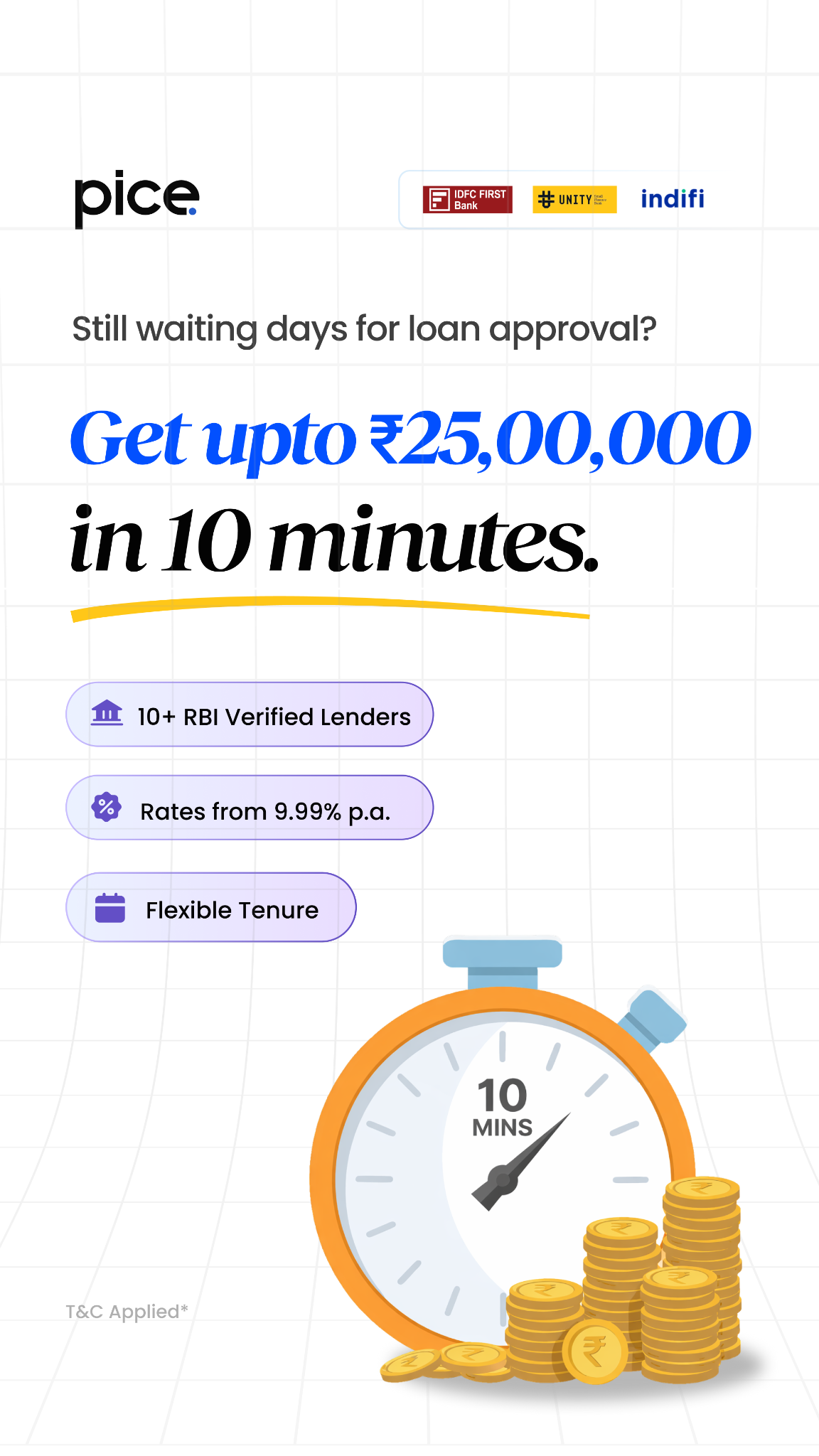
Pice: still waiting days for loan approval? — answered with a ten-minute disbursal. Still running, live 20 days, with three near-identical copies alongside it. And that is one creative line out of many: the same brand is running a second family of ads on need quick cash? with twelve near-identical copies behind it. One advertiser, two offers, fifteen simultaneous variants in your auction.

Paisabazaar, a marketplace rather than a lender, bidding for the same credit-curious user with say yes and the loan is yours. Ran 7 days.

GoodScore, which doesn't lend at all — it sells a credit-score improvement service at ₹99 a month. Ran 85 days, the longest of the three.
A loan app, a marketplace and a credit-repair service are not competitors in any product sense. In the auction they are, because they want the same impression. Your CPM in lending is set by how many of these are funded this quarter and how many variants each is running — not by your creative.
2. Season
Festive periods compress a year of retail intent into six weeks, and every brand bids into it at once.

Milkbasket's Diwali ad — up to 60% off cleaning essentials — ran 7 days, which is the shape of almost all festive creative: a short, expensive burst into the most crowded auction of the year.
The budget you modelled in August does not buy the same impressions in October. If the calculator says ₹3 lakh buys X results, that's an August X. Plan festive separately or you'll report a failure that was actually a price change.
3. Audience size
Narrow audiences cost more per impression because you're competing for a smaller pool. A tight audience can still be cheaper per result — judge at CPA, never at CPM.
4. Placement mix
Excluding Audience Network and Reels to protect brand safety removes the cheap inventory first. That decision has a price; it belongs in the calculator as a higher CPM, not in a quarterly surprise.
5. Creative
Relevance pulls CPM down, and the clearest public proxy for relevance is shelf life — ads the auction keeps rewarding stay live.

Why didn't we book this sooner? — a hesitation hook from a tropical lodge. Ran 83 days.

A founder explaining that four years of work produced only two products. Ran 77 days. Both are arguments rather than announcements, and both lasted about three months.
Now the other kind.

boAt's teaser for an unreleased product. Ran 5 days.

Bikanervala announcing two store openings. Ran 3 days.
Nothing is wrong with either — they are announcements, and an announcement expires when the thing it announces arrives. But an account built entirely from announcements pays for the learning phase over and over, and that shows up in your reporting as a CPM problem when it is really a creative-calendar problem. Three months of relevance versus three days is not a small difference in what you pay per impression.
Four ways the calculator's output will lie to you
- Your CTR is from your best ad, your CPM is from your worst week. Mixing a good number with a bad one produces a forecast that matches no real month. Use blended account averages from the same period.
- Reported conversions overstate reality. Attribution windows, view-through and modelled conversions all inflate. Compare Meta's number to your own backend before you trust the ROAS line.
- Frequency isn't in the model. Costs rise as you exhaust an audience, so a forecast built at today's frequency breaks at triple the budget. The chain is linear; the auction isn't.
- Offline conversions are invisible unless you send them. For any business where the sale closes on a call or a site visit — clinics, solar, education, property — the calculator's close-rate box is doing work that Meta can't see at all unless you're feeding conversions back.
The version of this that uses your real numbers
Everything above is estimation. The useful version replaces every input with what your account actually did — blended CPM by campaign and season, CTR by format, conversion rate by landing page, close rate by source — and then flags where the chain is leaking.
That's an audit, and it's the thing worth doing before you change a budget. Marxx runs one across your full creative history rather than the last thirty days, and writes the fix next to each flag rather than handing you a list of symptoms.
Book a free account audit — we'll run your numbers through this chain live and show you which lever is actually costing you money. If you want to go straight to the component numbers, the CPM calculator and ROAS calculator are open to use.
FAQs
How much do Facebook ads cost?
There is no useful universal answer — CPM is an auction outcome that varies by category, audience, placement, geography and season. The answerable question is what you can afford to pay: average order value × gross margin gives your maximum CPA, and everything else works backwards from there.
What is a good CPM on Facebook?
One below the maximum your margin can carry at your conversion rates. Published averages tell you about other people's auctions. Calculate your own ceiling instead, then judge the number you're actually being charged against it.
How much budget do I need to start Facebook ads?
Enough for one ad set to get roughly 50 optimisation events a week — about 50 × your expected CPA per week, or around 215 × CPA per month. Below that you're paying for a permanent learning phase rather than for results.
Why did my CPM suddenly increase?
Most often seasonality or auction competition rather than anything you did. One advertiser in your category running fifteen variants at once moves the price for everyone. Check whether the rise is category-wide before rebuilding campaigns — and check frequency, because an exhausted audience raises costs on its own.
Should I lower CPM or improve conversion rate?
Usually conversion rate. CPM is an auction outcome you only influence; the landing page and the offer are entirely yours, and in the chain above a 10% improvement to either is worth the same as 10% more budget — permanently, and for free.
Does a lower CPM mean better performance?
No. Cheap impressions shown to the wrong people are the most common way to waste a budget efficiently. Judge at cost per acquisition; CPM is an input, not a result.
Does creative really affect what I pay per impression?
Yes, and shelf life is the visible proxy. In the examples above, two argument-led ads ran 83 and 77 days while two announcements ran 5 and 3. An account made of announcements re-enters the learning phase constantly, and pays for it.
How do I estimate costs for a new account with no data?
Start with a competitor's visible creative and your own margin maths rather than a published average: set your max CPA from AOV and margin, assume conservative CTR and conversion rates, and treat the first month's spend as the cost of replacing those guesses with your own numbers.