# How to Optimise Facebook and Instagram Ad Campaigns (2026 Playbook)

> Meta automated the knobs. This playbook is what's left: the order of leverage, the diagnostics to run before changing anything, and the weekly rhythm that keeps an account improving.
- **Author**: Marxx
- **Published**: 2026-09-27
- **Category**: Agency operations
- **URL**: https://marxx.ai/posts/optimise-facebook-instagram-ad-campaigns

---

Most "optimisation" advice is still about knobs: bid caps, ad set splits, placement toggles. Meta automated nearly all of that. What's left decides almost everything, and it sits in a different order than most accounts are managed in.

This playbook is the order we work in, the diagnostics we run before changing anything, and the weekly rhythm that keeps an account improving instead of oscillating.

## Where the leverage actually is

| Lever | Realistic impact | How often it gets attention |
|---|---|---|
| **Creative -- new concepts, not variations** | Largest single lever in almost every account | Monthly, if that |
| **Offer and its job in the ad** | Very large, and free to change | Rarely revisited |
| **Measurement quality** (pixel, CAPI, event choice) | Large, and silently caps everything above it | Set up once, never audited |
| **Post-click** (page speed, message match, lead follow-up) | Large, cheapest to fix | Someone else's job |
| **Structure** (campaigns, ad sets, consolidation) | Moderate | Weekly |
| **Bids, budgets, schedules** | Small, and mostly automated now | Daily |

Read that top to bottom before touching anything. Most accounts spend their week on the bottom two rows.

## Step 1: fix measurement before you optimise anything

You cannot optimise toward a signal you aren't sending correctly. Before any creative or budget work:

- **Pixel and CAPI both live, deduplicated by event ID.** Browser-only tracking undercounts; both without dedupe double-counts. Either way the algorithm learns from a distorted picture.
- **Optimise for the deepest event with real weekly volume.** Purchase or qualified lead if volume allows; a shallower event only when the deep one can't produce enough signal to learn from.
- **Send the outcomes that happen offline.** For lead gen, that means qualified, booked and won going back with values. Otherwise Meta optimises for form fills, finds you people who fill forms, and everyone concludes the leads are junk.
- **Agree the attribution setting and stop re-litigating it weekly.** Pick one, report against it, and check it against your own back-end numbers monthly rather than arguing about which platform is right.

If measurement is wrong, everything below this line is guesswork with a dashboard attached.

## Step 2: simplify the structure

The 2026 default is fewer, bigger, broader:

| Do | Why |
|---|---|
| Consolidate ad sets | Every split divides the conversion data the system learns from |
| Let budget sit at campaign level | Manual per-ad-set budgets fight the allocation engine |
| Keep audiences broad, with exclusions | Targeting is now mostly the creative's job |
| Run 3-6 distinct ads per ad set | Enough to compare, few enough for each to get data |
| Separate prospecting from retargeting | Different jobs, different creative, different reporting |

When to break the rule: a genuinely different economics or geography (a new city, a premium tier, a B2B segment) deserves its own campaign, because you need to control and read its spend separately.

Two structural habits worth dropping: editing live ad sets mid-learning (every significant edit restarts it), and duplicating winners endlessly. Duplication buys you more copies of an idea that is already fading.

## Step 3: treat creative as the optimisation lever it is

Here's the distinction that matters most, in real ads. Four advertisers, four categories, four different tensions:

<div style="display:flex;align-items:flex-start;gap:8px;overflow-x:auto;padding-bottom:6px;margin:8px 0">
<img src="https://marx-ad-assets.s3.ap-south-1.amazonaws.com/116772528383864/652383647352915/image_0.jpeg" alt="Apollo Hospitals Meta ad: &quot;Your company covers you. But what about your family?&quot; -- family health checks and a tax exemption" style="flex:0 0 24%;height:auto;border-radius:8px">
<img src="https://marx-ad-assets.s3.amazonaws.com/ads/106275231291705/1029370963295364/e9d234f3.jpg" alt="Pixis Meta ad: &quot;See your new website before you commit&quot; -- a designed site live in days, not months" style="flex:0 0 24%;height:auto;border-radius:8px">
<img src="https://marx-ad-assets.s3.amazonaws.com/ads/337802730257/1532403001703219/07b86285.jpg" alt="Oberoi Hotels Meta ad: &quot;Where time is entirely yours&quot; -- a seaside sanctuary in the city" style="flex:0 0 24%;height:auto;border-radius:8px">
<img src="https://marx-ad-assets.s3.amazonaws.com/ads/111562321939314/1066474812440588/642b522b.jpg" alt="Moxie Beauty Meta ad: &quot;Thought your hair was frizzy and poofy your whole life? Think again&quot;" style="flex:0 0 24%;height:auto;border-radius:8px">
</div>

Healthcare reframing a corporate policy as a gap in family cover. A web-design service removing the risk of commissioning. A hotel selling time rather than a room rate. Haircare telling you that the thing you have called frizz your whole life is something else. Four concepts you can learn something from, because each tests a different belief about the buyer.

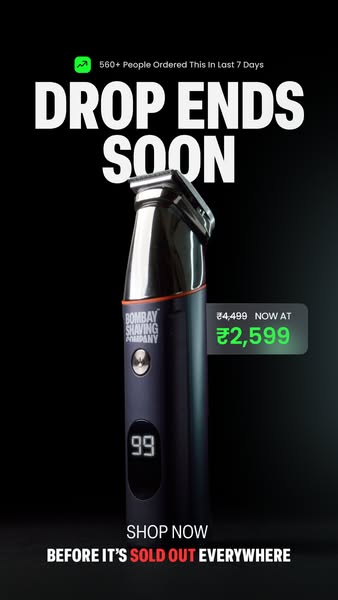
Now the same month from one grooming brand:

<div style="display:flex;align-items:flex-start;gap:8px;overflow-x:auto;padding-bottom:6px;margin:8px 0">
<img src="https://marx-ad-assets.s3.ap-south-1.amazonaws.com/1737772143174400/728505846683003/image_0.jpg" alt="Bombay Shaving Company Meta ad: &quot;Drop ends soon&quot; for the full body trimmer" style="flex:0 0 32%;height:auto;border-radius:8px">
<img src="https://marx-ad-assets.s3.ap-south-1.amazonaws.com/1737772143174400/617632631240293/image_0.jpg" alt="Bombay Shaving Company Meta ad: &quot;Last 24 hours to shop&quot;, buy 3 for INR 999" style="flex:0 0 32%;height:auto;border-radius:8px">
<img src="https://marx-ad-assets.s3.ap-south-1.amazonaws.com/1737772143174400/1335339798471998/image_0.jpg" alt="Bombay Shaving Company Meta ad: &quot;Left something behind? Last chance for 10% off in your cart&quot;" style="flex:0 0 32%;height:auto;border-radius:8px">
</div>

Three ads, one idea: buy now because the price is about to move. They'll work -- deadline creative usually does -- but no result here tells you anything you didn't already know. The rules we hold to:

- **Test concepts, not wording.** A headline swap teaches you about a headline. A different tension teaches you about your audience.
- **3-5 new concepts a month minimum**, more if spend is meaningful. Winners then get variations, not the other way round.
- **Cut for placement properly.** 9:16 for Reels and Stories, 4:5 for feed, with text out of the safe zones. A cropped feed square in Reels is a self-inflicted CPM penalty.
- **Give the offer a named job.** Hook, reward, or hesitation-reducer. If it's always the hook, your creative shelf life is about a fortnight.

On that last point, in one account we analysed, offer-led and price-led hooks (61% of everything it ran) averaged about 12 days live. The rare problem-led creative averaged 37. Discount creative isn't wrong; relying on it exclusively is what puts you on a treadmill.

## Step 4: diagnose before you change anything

"CPA is up" is not a diagnosis, and the fix depends entirely on why. These are the failure modes worth naming, and what each one actually calls for:

<div style="background:#0f1115;color:#e6e8ec;border-radius:12px;padding:18px 20px;font-family:-apple-system,Helvetica,Arial,sans-serif;line-height:1.55;margin:8px 0">
<div style="font-weight:700;color:#fff;margin-bottom:12px">Eight ways a creative stops working -- and the move for each</div>
<div style="border-left:3px solid #ff6b6b;padding:2px 0 2px 12px;margin-bottom:12px"><b style="color:#ff8f8f">Offer fatigue</b> -- the audience has seen this deal.
<span style="color:#9aa0a8">Change the offer's job, or the offer. Not the image.</span></div>
<div style="border-left:3px solid #ffc14d;padding:2px 0 2px 12px;margin-bottom:12px"><b style="color:#ffc14d">Burnout starting</b> -- early decline, still profitable.
<span style="color:#9aa0a8">Queue the replacement now; don't wait for it to break.</span></div>
<div style="border-left:3px solid #ffc14d;padding:2px 0 2px 12px;margin-bottom:12px"><b style="color:#ffc14d">High CTR, low sales</b> -- the ad promises something the page doesn't keep.
<span style="color:#9aa0a8">Fix message match on the landing page before touching the ad.</span></div>
<div style="border-left:3px solid #ffc14d;padding:2px 0 2px 12px;margin-bottom:12px"><b style="color:#ffc14d">Costs rising, still working</b> -- competition or seasonality.
<span style="color:#9aa0a8">Hold, watch frequency, prepare a new angle rather than cutting spend reflexively.</span></div>
<div style="border-left:3px solid #ffc14d;padding:2px 0 2px 12px;margin-bottom:12px"><b style="color:#ffc14d">Clicks too expensive</b> -- weak hook, wrong placement, or crowded auction.
<span style="color:#9aa0a8">Rework the first second, and check the placement cut.</span></div>
<div style="border-left:3px solid #ff6b6b;padding:2px 0 2px 12px;margin-bottom:12px"><b style="color:#ff8f8f">Only existing buyers left</b> -- you're paying to reach your own customers.
<span style="color:#9aa0a8">Exclusions, and a concept aimed at someone who has never heard of you.</span></div>
<div style="border-left:3px solid #ff6b6b;padding:2px 0 2px 12px;margin-bottom:12px"><b style="color:#ff8f8f">Wrong audience</b> -- engagement without intent.
<span style="color:#9aa0a8">The creative is selecting the wrong person. Change the moment it speaks to.</span></div>
<div style="border-left:3px solid #4dd4a6;padding:2px 0 2px 12px"><b style="color:#4dd4a6">Cold start failure</b> -- never got out of learning.
<span style="color:#9aa0a8">Consolidate, raise the budget floor, or optimise a shallower event until volume exists.</span></div>
</div>

Pick the name before you pick the action. Half of all account thrash is the right fix applied to the wrong diagnosis.

## Step 5: manage fatigue on a schedule, not a hunch

Fatigue is a composite, not a single metric: CTR decline carries the most weight, frequency the least, and it's worth reading on a five-level scale -- healthy, watch, moderate, high, critical -- so that "watch" triggers a brief and only "high" triggers a replacement.

Before the thresholds, the shape of the problem. These two ads come from the same feed, in the same month:


<div style="display:flex;align-items:flex-start;gap:10px;flex-wrap:wrap;margin:8px 0">
<img src="https://marx-ad-assets.s3.amazonaws.com/ads/123033644409827/1643389353872896/723b78a3.jpg" alt="Nerolac Meta ad: NxtGen painting services -- expert painters, perfect colours, everything handled" style="flex:0 0 46%;max-width:320px;height:auto;border-radius:10px">
<img src="https://marx-ad-assets.s3.ap-south-1.amazonaws.com/108524148603916/1382702923570682/image_0.jpeg" alt="The Good Bug Meta ad: &quot;Last 24 hours! Up to 50% off plus a free sipper&quot;" style="flex:0 0 46%;max-width:320px;height:auto;border-radius:10px">
</div>

The painting-service ad, which sells a standing need, ran **31 days** and its siblings ran 24 and 67. The flash-sale ad, which sells a deadline, lasted a day by design. Both are correct -- but if your whole account looks like the one on the right, you are rebuilding your creative library every fortnight and calling it optimisation.

Practical thresholds to start from and then tune to your own account:

| Signal | Watch it when | Act when |
|---|---|---|
| CTR trend | Down two weeks running | Down three weeks, or down a third from peak |
| Frequency (7-day, prospecting) | Above 2.0 | Above 3.5 with rising CPA |
| Share of spend on one creative | Above 40% | Above 60% with any decline |
| Creative age | Past 30 days | Past 60 days with no refresh queued |

The rule that saves the most money: **refresh before the decline, not after**. Once a creative carrying most of your spend breaks, you have no replacement warmed up and the whole account dips while something new learns.

## Step 6: scale without breaking learning

- Raise budgets **20-30% at a time**, then leave it alone for 48-72 hours.
- Scale **concepts**, not copies. More budget behind a fading idea just buys fatigue faster.
- Before any significant increase, check the diagnosis above. Scaling "costs rising, still working" is fine; scaling "only existing buyers left" is lighting money on fire.
- When you cut, cut spend to the ad, not the campaign, so the campaign keeps its learning.

## Step 7: audience, in the order that matters now

1. **Broad prospecting with exclusions** (existing customers, recent purchasers, current leads) as the default.
2. **Retargeting as a separate campaign** with genuinely different creative -- the objection-handling and proof work, not the same prospecting ad at a higher frequency.
3. **Interest stacks only where they're genuinely distinct** -- a corporate buyer, a school decision-maker, a different city with different economics.
4. **Lookalikes as a supplement**, built from your best-value seed (purchasers, qualified leads), not from all leads.

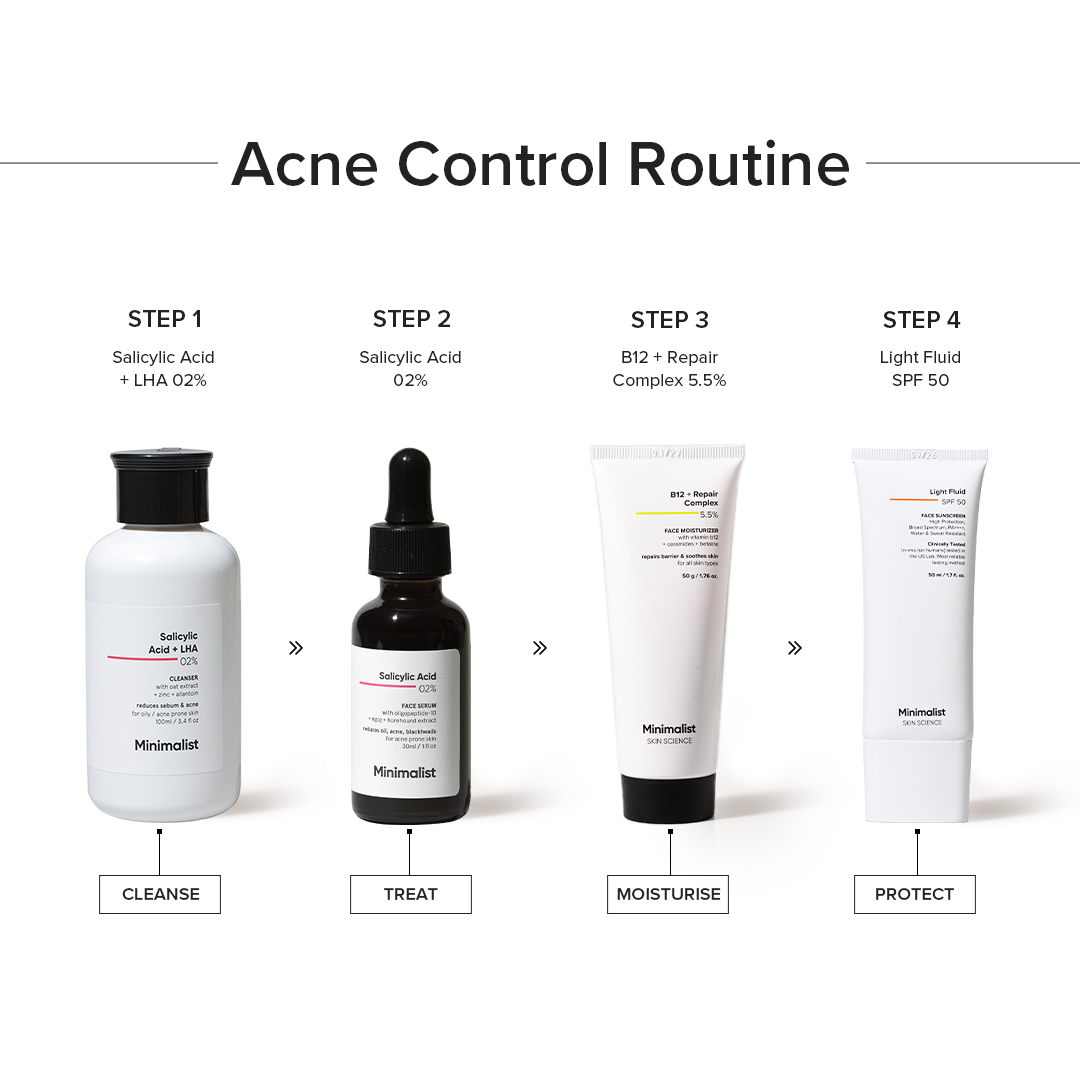
Those first two rows need genuinely different creative, and it's visible at a glance:

<div style="display:flex;align-items:flex-start;gap:10px;flex-wrap:wrap;margin:8px 0">
<img src="https://marx-ad-assets.s3.amazonaws.com/ads/107597820995682/1571114231310679/323b4810.jpg" alt="Minimalist Meta ad: a four-step acne control routine laid out as numbered products" style="flex:0 0 46%;max-width:320px;height:auto;border-radius:10px">
<img src="https://marx-ad-assets.s3.amazonaws.com/ads/102929252093077/1738830647134668/6983640e.jpg" alt="Perfora Meta ad: &quot;Still in cart? Your whiter teeth is waiting&quot; -- a cart-abandonment reminder" style="flex:0 0 46%;max-width:320px;height:auto;border-radius:10px">
</div>

The first one teaches a stranger the whole regimen before asking for anything. The second assumes you already looked and handles the hesitation. Running the first at a stranger is prospecting; running it at someone with an abandoned cart is just paying to repeat yourself.

The single biggest audience lever in 2026 is still the creative: the ad selects the person far more reliably than the targeting box does.

## Step 8: the part after the click

- **Speed.** A page that takes four seconds throws away a chunk of the traffic you just paid for.
- **Message match.** The ad's promise should be the first thing on the page, in the same words. "High CTR, low sales" is usually this.
<div style="margin:8px 0">
<img src="https://marx-ad-assets.s3.amazonaws.com/ads/1227086873991372/4420858114898106/d81ca848.jpg" alt="MCaffeine Meta ad: &quot;Buy 3 at INR 999&quot; with the code BUY999" style="width:100%;max-width:340px;height:auto;border-radius:10px;display:block;margin:0 auto">
</div>

An ad like this one sets an exact expectation: a code, three products, INR 999. If the landing page opens on anything other than that offer, in those words, the click is wasted -- and the account will read it as creative fatigue rather than a broken promise.

- **Form friction.** Every extra field costs completions; ask only what routing genuinely needs.
- **Speed-to-lead.** For lead gen, minutes matter more than any bid setting. Capture by webhook, route to an owner, and send the qualified outcome back to Meta.

## The weekly operating rhythm

| When | What | Output |
|---|---|---|
| **Monday** | Read creative-level performance, not account totals. Name the diagnosis for anything declining. | One kill, one scale, one brief |
| **Wednesday** | Launch the queued concepts. Check placements and tracking on launch. | New creative live |
| **Friday** | Check frequency and fatigue levels, and what competitors shipped this week. | Next week's brief |
| **Monthly** | Measurement audit, structure review, refresh the persona and offer thinking. | A short written decision list |

The discipline that matters: every week ends with something killed, something scaled, and something briefed. An account where nothing died this week isn't being optimised.

## Seven things not to do

- **Judging ads by three-day data.** Wait for the conversions, or you'll kill winners and scale noise.
- **Editing ad sets mid-learning.** You're restarting the very process you're impatient with.
- **Running the same creative in every placement.** Cheap to fix, expensive to ignore.
- **Optimising to the shallowest event forever.** Cheap "conversions" that never become revenue.
- **Adding budget to a fatigued winner.** More spend, faster decline.
- **Reporting account totals only.** Nothing to learn from; no creative decision can come out of it.
- **Changing five things at once.** Then nobody knows which one worked.

## The twelve-point account check

1. Pixel and CAPI both firing, deduplicated?
2. Optimising for the deepest event with real volume?
3. Offline outcomes written back with values?
4. Ad sets consolidated, budget at campaign level?
5. Exclusions applied to prospecting?
6. 3-6 distinct ads live per ad set?
7. How many genuinely new concepts shipped last month?
8. Placement-native cuts for 9:16 and 4:5?
9. Any single creative above 60% of spend?
10. Frequency and CTR trend on the top three ads?
11. Landing page speed and message match checked this quarter?
12. What did the last four weekly reports actually decide?

If more than three of those are "not sure", the problem isn't your bids.

## Demo: free account audit, with the fix written next to each flag

Give us read access for 30 minutes. We'll read 180 days of history, decode your creative by hook, offer, format and audience, score fatigue across five levels, name the failure mode behind anything declining, and set it beside what your category is actually running -- with a one-line fix next to every flag, whether or not you work with us.

[Book a demo](/book-a-demo), or see how the [creative intelligence](/features/creative-intelligence) behind the audit works.

## FAQs

### How do I optimise Facebook and Instagram ad campaigns in 2026?

In this order: fix measurement, simplify structure, ship genuinely new creative concepts, diagnose declines by name before acting, manage fatigue on a schedule, scale in increments, and fix the post-click experience. Bids and placements are the last and smallest lever.

### How often should I change my Facebook ads?

Refresh before the decline. Watch CTR trend, frequency and creative age together, and have the replacement briefed by the time a creative hits "watch" rather than waiting for it to break.

### How many ads should I run per ad set?

Three to six distinct ads. Fewer and you have nothing to compare; more and none of them gets enough data to prove anything.

### Should I use broad targeting or detailed interests?

Broad with exclusions as the default, and interests only where a segment is genuinely different in economics or message. Creative now does most of the targeting work.

### What's a good frequency for Meta prospecting campaigns?

Treat 2.0 as the point to start watching and 3.5 with rising CPA as the point to act. Retargeting tolerates more; prospecting rarely does.

### Why did my CPA go up when nothing changed?

Something changed -- usually creative fatigue, a shift in the auction, seasonality, or a tracking break. Name which one before you react. "Costs rising but still working" and "only existing buyers left" look identical in a CPA chart and need opposite responses.

### How long does the learning phase take?

Until the ad set accumulates enough conversions to stabilise, typically within a week at reasonable volume. Every significant edit restarts it, which is why consolidation and patience beat constant adjustment.

---
- [More Agency operations articles](https://marxx.ai/posts/category/agency-operations)
- [All articles](https://marxx.ai/posts)