Before you price a social listening tool, count what you actually have to listen to.
We checked three named Indian venues on Google Maps this week:
| Business | Public Google reviews |
|---|---|
| Snow World, Hyderabad | 19,302 |
| KidZania, Mumbai | 17,117 |
| Smaaash, Noida | 11,655 |

Roughly 48,000 pieces of written customer feedback across three businesses — free, public, already yours to read, and sitting on a surface most social listening tools treat as a secondary channel.
Now compare that to what the tools sell you.
What the entry plans actually give a small business
All prices below are from each vendor's own published pricing page.
| Tool | Entry price | What you get at entry | Refresh |
|---|---|---|---|
| Google Alerts | Free | Keyword alerts on web and news. No social, no reviews. | Varies |
| Google Business Profile | Free | Every review on your own listing, with replies | Live |
| Awario | $49/mo ($29 billed annually) | 3 topics, 30,000 new mentions/mo, 1 seat | — |
| Determ | €99/mo | 1 topic, 1,000 mentions | — |
| Brand24 | $249/mo ($199 annually) | 3 keywords, 2,000 mentions/mo, 1 user | Every 12 hours |
| Mention | On request | 75+ review sites incl. Google, Trustpilot, app stores | — |
| Marxx | From INR 10,000/mo | 20+ channels incl. reviews and ad comments, clustered into personas | — |
Two things jump out of that table.
Brand24's cheapest plan is $249/mo and refreshes twice a day. Awario's is $49 and gives you 30,000 mentions against Brand24's 2,000. Same category, 5x the price, 1/15th the volume. The difference is in sentiment depth and source breadth, not raw monitoring — but if monitoring is what you need, you're paying a large premium for a brand name.

The free row is the one most small businesses skip. Your own Google Business Profile holds more usable customer language than a $249/mo tool will surface for a business your size, because a business doing ₹50 lakh a year is not generating 2,000 social mentions a month. It's generating forty reviews and two hundred ad comments.
The free method, in about 20 minutes
Run this before you buy anything.
- Open your Google Business Profile and read your last 100 reviews — all of them, not the summary.
- Open Meta Ads Manager, go to any running ad, and open the comments. Read them.
- Open a sheet with three columns: what they praised, what they complained about, what they asked before buying.
- Tag every comment into one of the three. Don't write insights yet.
- Count the tags. Sort descending.

The question you're answering is "what do people say to me that I'm not saying back to them?" The top complaint usually belongs in your ad copy as a pre-emptive answer. The top pre-purchase question is usually the one your landing page doesn't address.
If that exercise produces fewer than fifty comments in total, you do not have a listening problem that $249/mo solves. You have a volume problem, and the fix is more customers, not more monitoring.
Honest limit: reviews are written by people at the extremes. Delighted and furious both write; satisfied-but-unmoved does not. So this method tells you your tails accurately and your middle badly. It also misses every conversation that never names you — which is exactly what the paid tools are for.
When paid listening is genuinely worth it
The free method breaks down in four situations, and each points at a different tool.
You sell nationally with no physical location. A D2C brand on marketplaces has almost no Maps reviews. Its conversation is on Instagram, Reddit and WhatsApp forwards. Awario at $49/mo is the cheap honest entry here.
You need to catch things fast. A 12-hour refresh is fine for trend reading and useless for a complaint spreading on a Saturday night. Check refresh rate before price.
You're tracking competitors, not just yourself. Most entry plans give you three keywords. Your brand, a misspelling of your brand, and one competitor — that's the plan gone.
You need the output to become creative, not a dashboard. This is the gap nobody prices honestly. Knowing that 14% of comments mention parking does nothing until it becomes an ad line.
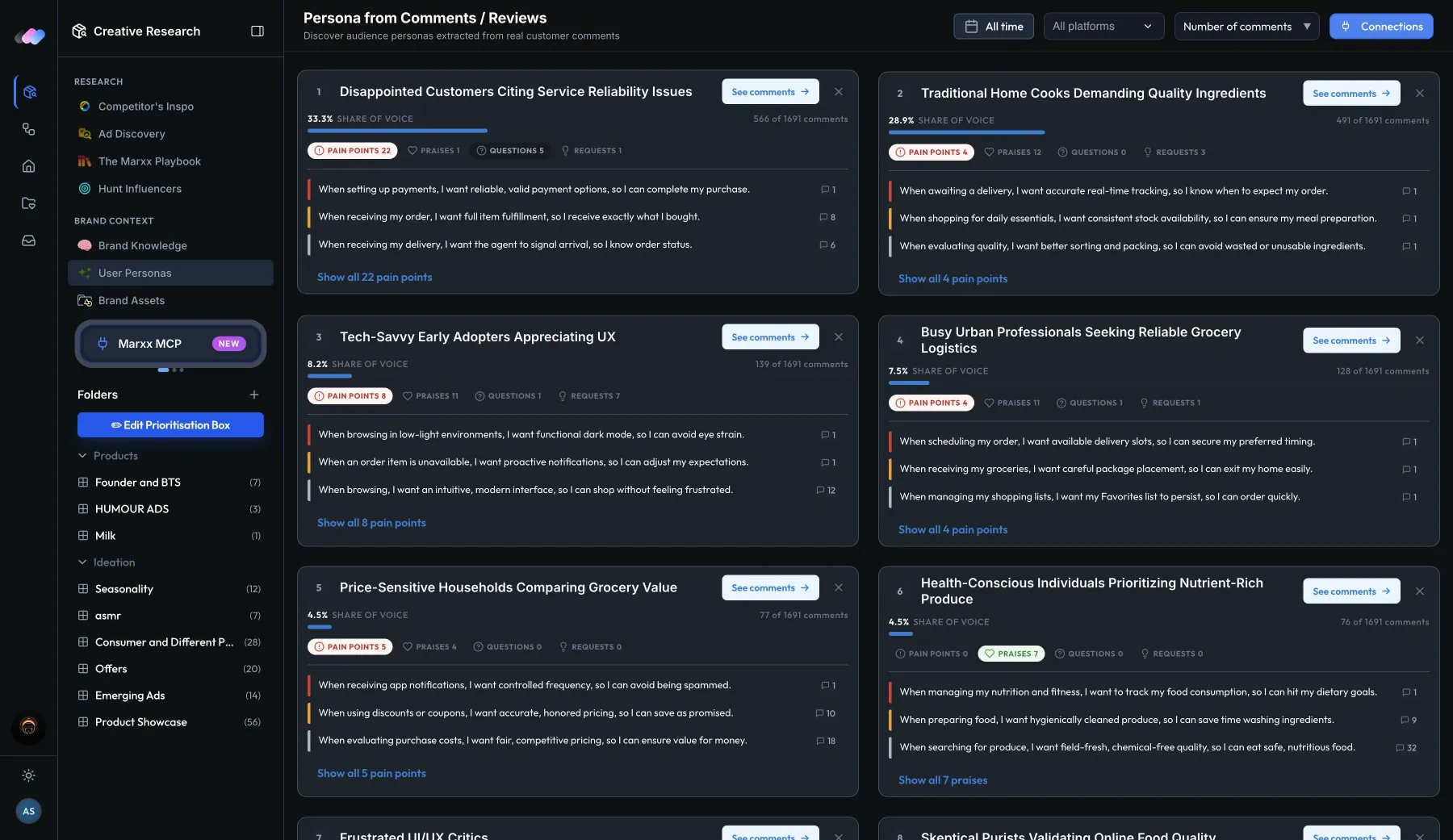
That last one is what our own personas feature is built for: 20+ channels read — reviews, app stores, Reddit, Google Maps, Instagram, ad comments — then clustered into named segments with the verbatim lines behind each pain point, so the output is copy you can run rather than a sentiment score.
Which to pick
| If you are... | Buy |
|---|---|
| A local business under 50 mentions/month | Nothing. Read your own reviews. |
| On a hard budget but genuinely need coverage | Awario, $49/mo |
| A single-brand business wanting European sources | Determ, €99/mo |
| An established brand needing sentiment depth | Brand24, from $249/mo |
| Review-heavy, across many review sites | Mention |
| Needing listening that ends in ad copy | Marxx, from INR 10,000/mo |
FAQ
Is there a genuinely free social listening tool? Google Alerts for web and news, and your own Google Business Profile for reviews. Between them they cover more than most small businesses need. Neither does sentiment analysis.
What's a reasonable budget? If listening costs more than 5% of your monthly ad spend, you're monitoring more than you're marketing.
Do I need sentiment analysis? At small volumes, no — you can read 100 comments yourself and judge better than a classifier. Sentiment scoring earns its keep above roughly 1,000 mentions a month.
Can these tools read WhatsApp? No. It's encrypted and private. For a lot of Indian small businesses that's where the real conversation is, and no tool on this list reaches it.
How often should I actually look? Weekly is enough for almost everyone. Daily monitoring on a business with forty reviews a month is theatre.
Build personas from what you already have
Personas built from your own reviews and ad comments. Book a demo — bring your Google Business Profile and one running ad, and we'll cluster the feedback into named segments with the verbatim lines attached.